How to Use AI for Content Writing: A Gentle, Human Guide
Writing has always been a deeply personal act. It is how we share what we know, connect with others, and express ideas that matter to us.
When Artificial Intelligence (AI) first arrived in the writing world, many creators felt hesitant. It was natural to wonder: Will it take the soul out of my work? Will everything sound robotic?
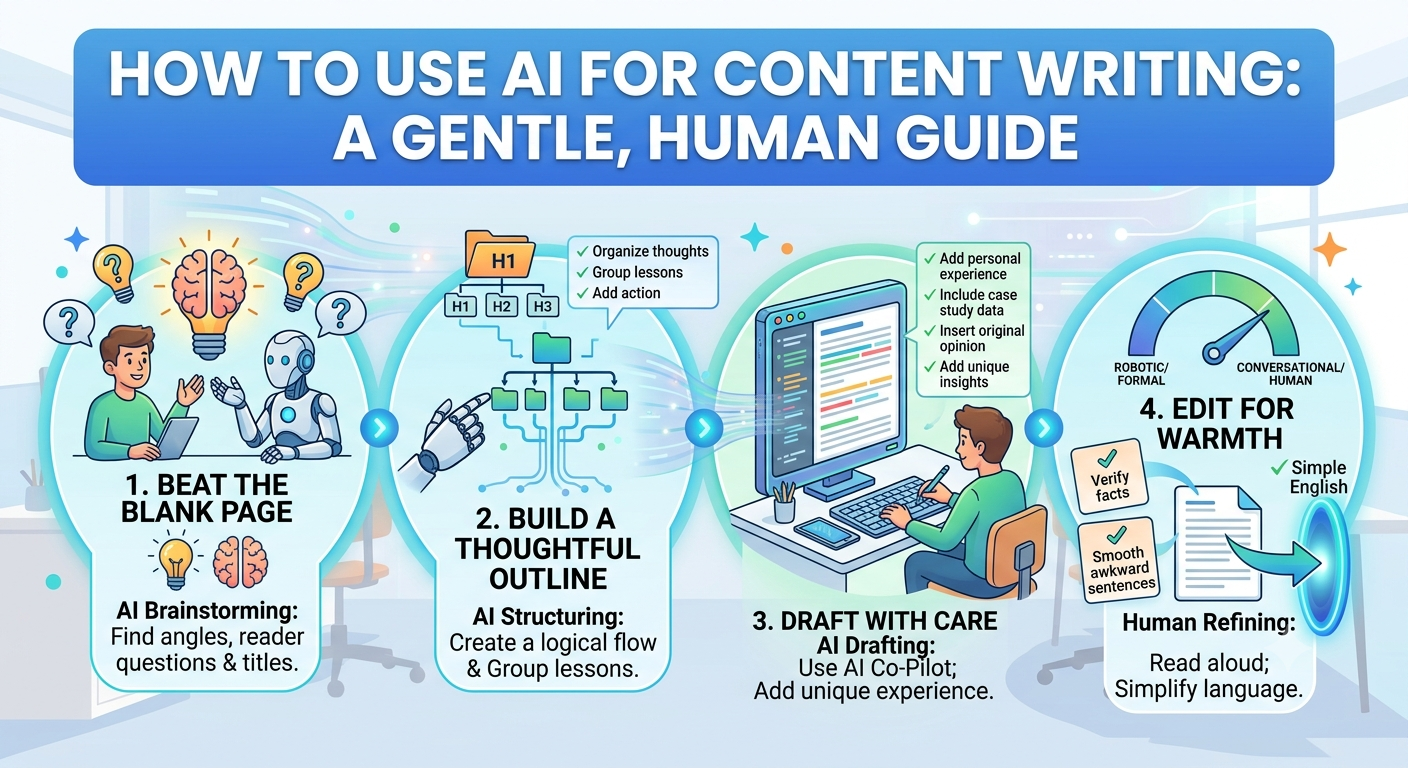
How to Use AI for Content Writing: A Gentle, Human Guide
The secret is seeing AI not as a writer that replaces you, but as a helpful companion sitting beside you. When used with care, AI helps you overcome blank screens, organize messy thoughts, and polish your words—while keeping your heart and voice at the center.
Here is a simple, gentle approach to using AI in your writing journey.
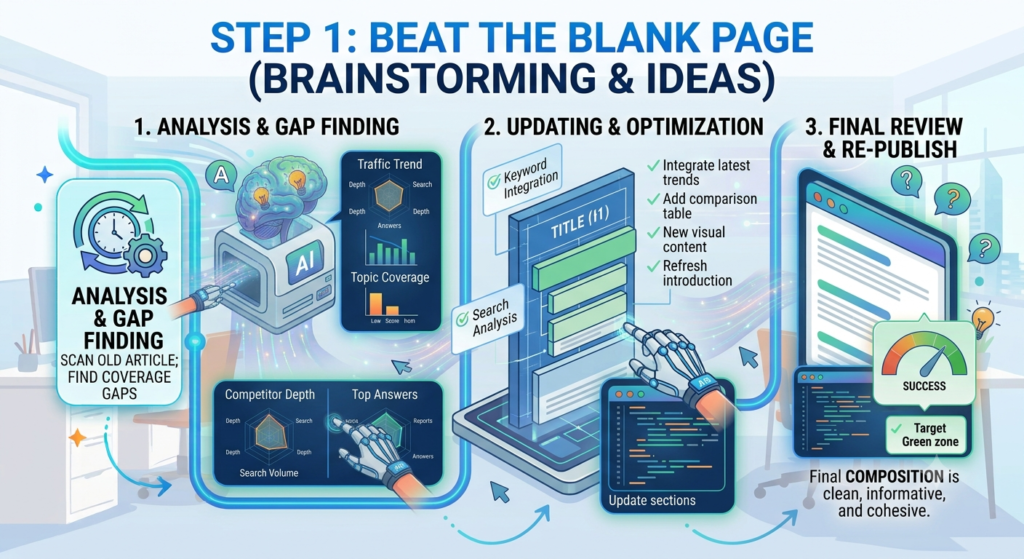
1. Beat the Blank Page (Brainstorming & Ideas)
Starting is often the hardest part. Staring at an empty white screen can feel overwhelming, even for seasoned writers.
Beat the Blank Page (Brainstorming & Ideas)
AI makes a wonderful brainstorming partner. Instead of asking it to write an entire article, invite it to explore possibilities with you.
Find fresh angles: Ask for unique ways to talk about a familiar subject.
Understand reader questions: Discover the real doubts and curiosities your audience might have.
Explore title concepts: Generate a few gentle, friendly headlines to find the right mood for your piece.
A Soft Prompt Idea: > “I want to write an encouraging article about starting a morning journal. Can you share five warm and relatable angles that would appeal to busy people?”
2. Build a Thoughtful Outline
Once an idea sparks your interest, a good structure keeps your thoughts organized. A clear outline makes the actual writing feel light and natural.
Instead of following rigid, mechanical templates, use AI to create a smooth, logical flow:
Introduction: Set a welcoming tone and validate the reader’s problem.
Core Lessons: Group your main thoughts into 3–4 bite-sized, easy-to-read sections.
Reflection & Action: End with an encouraging takeaway rather than a dry summary.
Review what the AI suggests. Keep the points that feel genuine and naturally delete anything that feels like unnecessary filler.
3. Draft with Care: The “Co-Pilot” Method
The most common mistake is letting AI write everything and hitting publish without looking back. That is how content loses its warmth.
A balanced approach works much better:
Your Personal Experience + AI Clarity & Structure = Engaging, Authentic Writing
Share your core thoughts: Type a messy, unedited voice note or a quick list of your thoughts.
Ask AI to arrange them: Let the tool shape your rough notes into clear, smooth sentences.
Bring back your voice: Read the output slowly. Swap out stiff words for simple, natural language you would use in a quiet conversation with a friend.
4. Edit for Warmth and Simplicity
AI often leans toward formal, corporate vocabulary—words like “delve,” “utilize,” “paradigm,” or “testament.” Real human writing is much simpler and kinder.
Use this gentle editing checklist:
Read it out loud: If a sentence makes you pause or sounds overly grand, simplify it.
Add personal moments: A short story, a mistake you made, or a tiny observation brings dry paragraphs to life.
Check the facts: AI can make honest mistakes with dates, data, and names. Always double-check facts before sharing them.
Keep paragraphs short: Give your reader plenty of breathing room on the page.
5. What to Keep, What to Outsource
What AI Does Wonderfully What Only You Can Bring
Organizing scattered thoughts into lists Your genuine feelings, empathy, and tone
Finding synonyms and rephrasing awkward phrases Real-life stories, lessons, and personal mistakes
Creating quick summaries and meta notes Final judgment, taste, and honesty
Checking basic grammar and flow True human connection and intuition
Conclusion: Writing with Heart in the Age of AI
At the end of the day, technology will keep evolving, but the reason we read remains the same: we want to feel understood, inspired, and connected to another human mind.
Artificial Intelligence is simply a canvas and a pen; you are still the artist. Let AI handle the heavy lifting of organizing and outlining so you can focus on what truly matters—sharing your authentic voice, your lived experiences, and your empathy with the world.
Step forward with curiosity, write with kindness, and remember: as long as you put your heart into your words, your content will always resonate deeply with real people.
Frequently Asked Questions (FAQs)
1. Will using AI make my writing sound robotic?
Only if you rely on it completely without editing. AI models tend to use formal or repetitive sentence structures. The best way to keep your writing warm and human is to treat the AI draft as a starting point. Read the text aloud, replace stiff words with natural everyday language, and add your own voice.
2. Can I get in trouble or penalized for using AI to write blog posts?
Search engines do not penalize content solely because AI helped create it. Their primary goal is to reward helpful, accurate, and high-quality writing created for real readers. However, if a website publishes low-quality, inaccurate, or unedited AI spam, it will struggle to rank. As long as you review the content and ensure it provides genuine value, using AI as an assistant is completely safe.
3. Which AI tools are easiest for beginners to use for writing?
Google Gemini, ChatGPT, and Claude: Excellent for brainstorming, conversational drafting, and refining rough thoughts.
Grammarly: Great for catching typos, smoothing tone, and improving readability without changing your core message.
Hemingway Editor: Wonderful for checking if your sentences are too long or complicated.
4. How can I add a “human touch” to an AI-assisted article?
Share real stories: Mention personal anecdotes, lessons learned, or common mistakes you’ve personally faced.
Use simple language: Swap complex jargon for conversational phrases you would use with a friend.
Express opinions: Share your honest point of view rather than just neutral facts.
Fact-check carefully: Ensure all statistics, names, and claims are accurate and up-to-date.
5. How much of the writing process should I let AI handle?
A great rule of thumb is the 70/30 rule: let AI handle roughly 30% of the repetitive legwork (like brainstorming topics, organizing bullet points, and checking grammar), while you provide the remaining 70% (strategy, personal insights, emotional tone, and final editing).