
AI vs. Traditional Marketing: Why AI-Driven Campaigns Win
If you’ve run marketing campaigns over the past decade, you know the drill: brainstorm creative ideas, draft copy, build audiences manually, set up A/B tests, and wait days (or weeks) to see what actually works.
For years, that traditional marketing playbook was the gold standard. But today, customer habits change in seconds, ad platforms demand real-time optimization, and data volumes are too massive for manual spreadsheets.
Enter AI-driven marketing.
Artificial intelligence isn’t just a buzzword or a fancy copywriting tool; it has completely transformed how businesses identify, engage, and convert customers.
In this guide, we break down AI vs. traditional marketing, explore why AI-driven campaigns consistently outperform legacy approaches, and look at how smart businesses combine the best of both worlds to maximize ROI.
What Is Traditional Marketing? (And Where It Struggles)
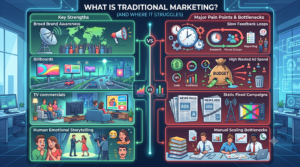
Traditional marketing—whether offline (print, billboards, TV, radio) or manual digital marketing (manual keyword bidding, standard email blasts, static display ads)—relies heavily on human execution and periodic reviews.
The Strengths of Traditional Marketing:
-
Brand Awareness: Billboards and TV spots build broad geographic recognition.
-
Human Emotional Touch: Masterfully crafted brand storytelling resonates deeply on a human level.
The Pain Points:
-
Slow Feedback Loops: Measuring campaign impact often takes weeks.
-
Broad Targeting (Wasted Spend): You pay to show ads to large audiences who may never need your product.
-
Static Execution: Once a campaign goes live, adapting it on the fly is costly and difficult.
-
Scaling Bottlenecks: Personalizing messaging for 10,000 distinct prospects manually is impossible.
What Is AI-Driven Marketing?
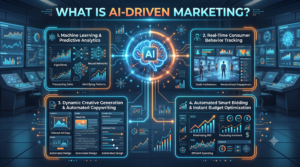
AI-driven marketing uses machine learning, predictive analytics, natural language processing (NLP), and automated algorithms to make data-backed marketing decisions in real time.
Instead of guessing what creative will convert, AI systems analyze live consumer behavior, predict intent, dynamic-test creative variations, and allocate budgets to the highest-performing segments automatically.
Head-to-Head Comparison: AI vs. Traditional Marketing
1-to-1 dynamic content & product recommendationsAd Spend EfficiencyHigher risk of ad fatigue and wasted budgetDynamic budget reallocation to high-converting assetsScalabilityLinear (requires more human hours)Exponential (handles millions of touchpoints seamlessly)
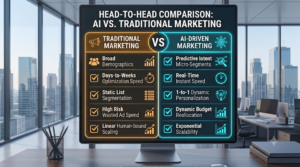
| Feature | Traditional Marketing | AI-Driven Marketing |
| Audience Targeting | Broad demographics (age, gender, location) | Predictive intent, micro-segments, real-time behavior |
| Optimization Speed | Days or weeks (manual analysis) | Real-time / Instantaneous |
| Personalization | Segmented lists (e.g., “All New Leads”) |
5 Reasons AI-Driven Campaigns Win Every Time
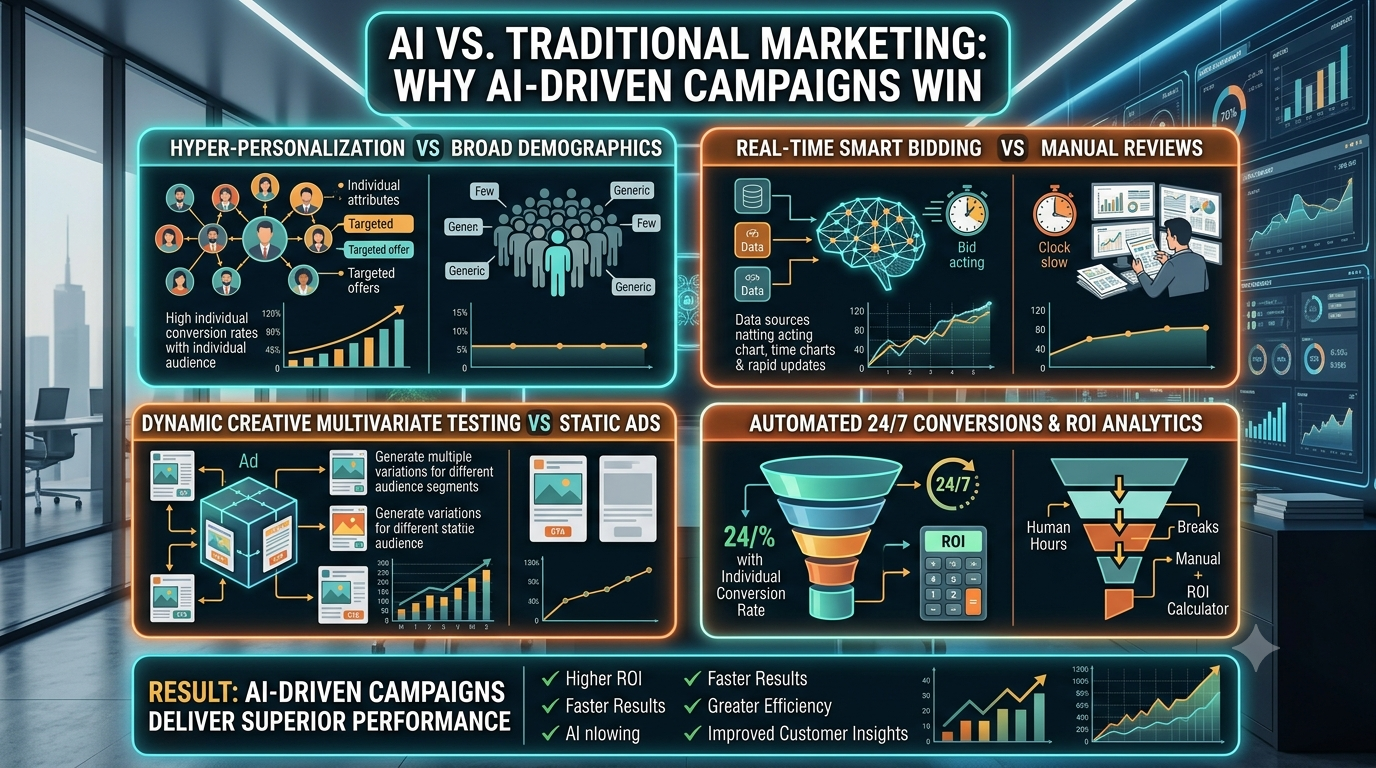
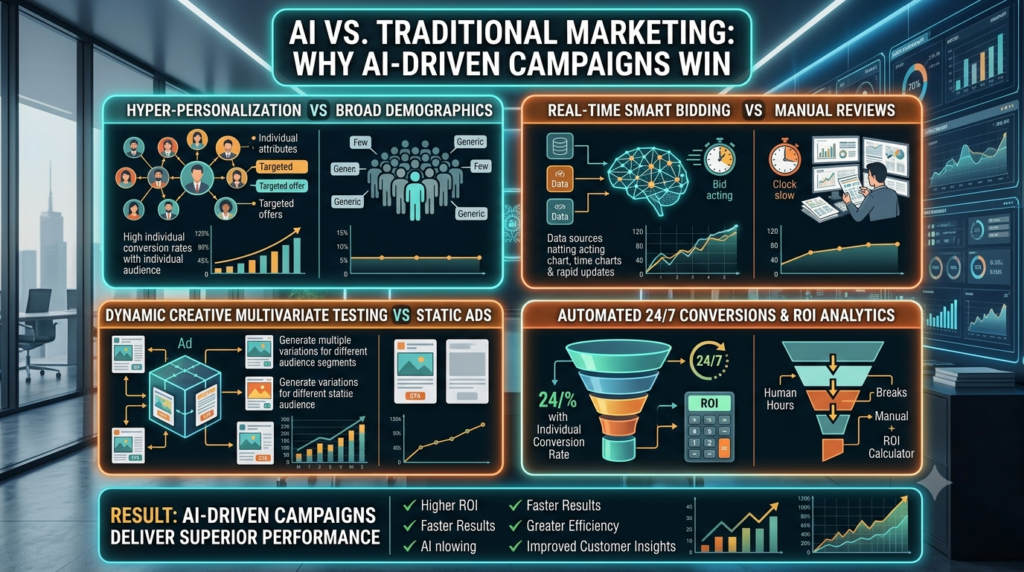
1. Hyper-Personalization at Scale
Generic broadcast messaging no longer converts. Today’s buyers expect content tailored to their exact stage in the buyer’s journey.
While traditional campaigns send the same newsletter or show the same banner ad to everyone, AI analyzes browsing patterns, previous interactions, and purchase history to serve personalized recommendations and dynamic ad copy tailored to each user.
2. Real-Time Predictive Analytics & Budget Allocation
In a traditional campaign, if an ad underperforms on a Tuesday, you might not notice until your weekly review on Monday.
AI algorithms monitor performance every second. If Creative A performs 20% better with a specific segment, the AI automatically shifts ad spend toward it immediately—slashing your Cost Per Acquisition (CPA).
3. Smarter Creative & Dynamic Multivariate Testing
A/B testing two ad headlines manually is slow. AI platforms can generate, test, and analyze dozens of visual and headline combinations simultaneously. It detects which copy angles convert specific audiences and optimizes the creative mix automatically.
4. 24/7 Lead Nurturing & Instant Conversions
When a prospect visits your website at midnight, traditional methods make them fill out a static form and wait 24–48 hours for a reply. AI conversational bots engage visitors instantly, qualify intent, answer complex product questions, and book sales calls directly on the calendar.
5. Deeper Customer Lifecycle & Churn Prediction
AI doesn’t stop working after the initial conversion. Machine learning models track post-purchase behavior to identify cross-sell opportunities and flag early signs of customer churn before it happens—allowing retention teams to step in proactively.
The Big Myth: Does AI Replace Human Marketers?
No. AI wins at data processing, pattern detection, and speed—but it lacks genuine human empathy, strategic vision, and brand intuition.
The most successful modern campaigns follow a Hybrid Model:
-
Humans provide: Strategic direction, brand voice, emotional storytelling, and ethics.
-
AI provides: Speed, audience segmentation, real-time bidding, and performance optimization.
Marketers who leverage AI don’t work less—they work smarter, focusing on high-level strategy while automation handles repetitive legwork.
How to Transition Your Marketing Strategy Toward AI
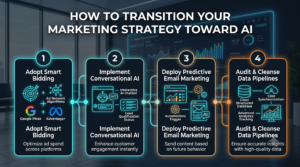
If you want to modernize your marketing workflow without overhauling your entire stack overnight, start here:
-
Adopt Smart Bidding: Let ad network algorithms (Meta Advantage+, Google Performance Max) optimize bids based on conversion signals.
-
Implement Conversational AI: Replace passive lead capture forms with interactive AI assistants.
-
Use Predictive Email Tools: Send automated emails based on individual subscriber engagement habits rather than fixed blast schedules.
-
Audit Your Data Cleanliness: AI runs on data. Ensure your website tracking, pixels, and CRM pipelines are clean and properly connected.
Conclusion
The debate between AI and traditional marketing isn’t about choosing one over the other—it’s about evolution. While traditional marketing built the foundation of brand awareness and emotional connection, manual execution simply cannot keep pace with today’s fast-moving, data-rich market.
AI-driven campaigns win because they:
-
Eliminate Guesswork: Decisions are powered by live consumer data rather than gut feeling.
-
Maximize Every Dollar: Budgets shift instantly toward high-converting creatives and audiences.
-
Deliver True Personalization: Prospects receive relevant messaging tailored to their exact buying journey.
The ultimate competitive advantage belongs to businesses that master the hybrid approach—combining authentic human storytelling and strategy with the analytical power and speed of AI.
If you want to reduce customer acquisition costs, eliminate wasted ad spend, and build campaigns that scale sustainably, the time to integrate AI into your marketing playbook is now.
FAQs:
1. What is the main difference between AI marketing and traditional marketing?
Traditional marketing relies on manual execution, broad audience segmentation, and periodic reviews (often weekly or monthly). AI-driven marketing uses machine learning and predictive analytics to analyze live consumer data, optimize bids, test creatives, and personalize user experiences automatically in real time.
2. Will AI completely replace human marketers?
No. AI lacks emotional intelligence, brand intuition, and long-term strategic vision. Instead of replacing marketers, AI acts as a force multiplier—handling repetitive data analysis, multivariate testing, and real-time optimization so human marketers can focus on high-level strategy, creative storytelling, and customer psychology.
3. How does AI-driven marketing improve campaign ROI?
AI improves Return on Investment (ROI) by:
-
Automatically reallocating ad spend toward top-performing creatives and audiences.
-
Lowering Cost Per Acquisition (CPA) through predictive intent targeting.
-
Reducing wasted ad spend on unqualified leads.
-
Delivering hyper-personalized product recommendations that boost conversion rates.
4. Is AI marketing expensive for small businesses?
Not anymore. Most modern ad networks (like Meta Ads and Google Ads) already have built-in AI tools (such as Advantage+ and Performance Max) available at no extra cost. Additionally, affordable AI platforms for copywriting, email marketing, and automated customer support allow small businesses to scale without massive enterprise budgets.
5. Can traditional marketing still work alongside AI?
Yes. The most effective strategy is a hybrid approach. For example, a business might use traditional brand storytelling or local outdoor advertising to build baseline trust and awareness, while using AI-powered digital campaigns, retargeting, and automated lead nurturing to capture and convert high-intent prospects.