If you’re a developer, you’ve likely felt that “sticker shock” when the monthly OpenAI API bill hits your inbox. Reasoning models—the ones that actually “think” before they speak—have traditionally been a luxury. But with the rise of DeepSeek R1, the game has officially changed.
Today, we’re breaking down the math. Should you keep paying the “OpenAI Tax,” or is DeepSeek R1 the budget-friendly powerhouse you’ve been waiting for?
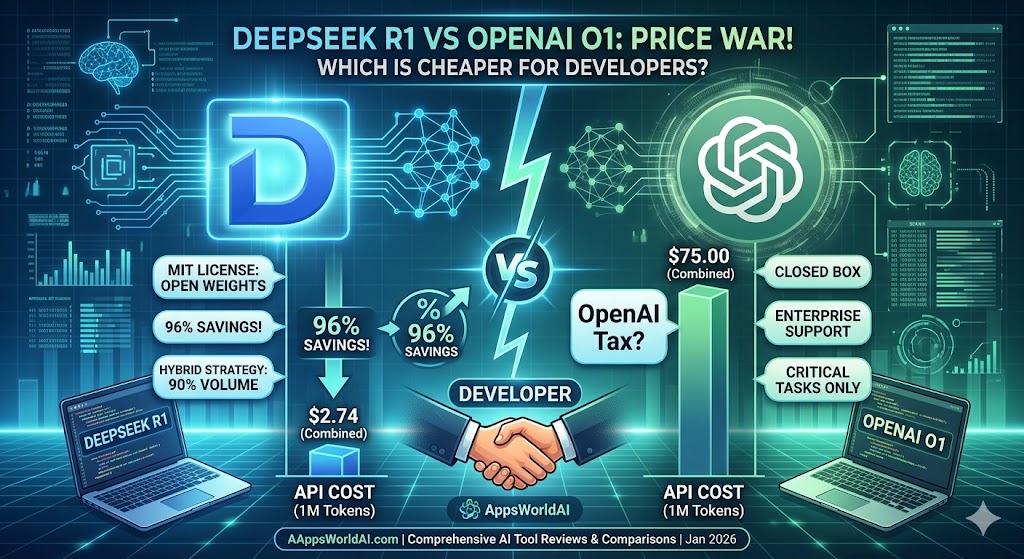
1. The Shocking Price Gap (Numbers Don’t Lie)
Let’s get straight to the point: DeepSeek R1 hasn’t just lowered the price; it has disrupted the entire economy of AI reasoning. If we look at the cost per 1 million tokens, the difference is staggering:
| Metric | DeepSeek R1 (Direct API) | OpenAI o1 | The Winner |
| Input Cost (per 1M tokens) | ~$0.55 | $15.00 | DeepSeek R1 |
| Output Cost (per 1M tokens) | ~$2.19 | $60.00 | DeepSeek R1 |
| Potential Savings | ~96% Cheaper | – | – |
In simple terms: A task that costs you $100 on OpenAI o1 will cost you roughly $4 on DeepSeek R1. For a scaling startup, that is the difference between staying in business and going bust.
2. The Hidden Cost of “Thinking” Tokens
Both models use “Chain of Thought” (CoT) processing. This means they generate “hidden” tokens while they calculate the best answer.
- OpenAI o1: These thinking tokens are billed at the same high rate as regular output. If your prompt is complex, your budget can vanish in minutes.
- DeepSeek R1: Because the base cost is so low, you can let the model “think” deeply without constantly checking your credit balance.
3. The “Open Weights” Advantage (MIT License)
Here is where DeepSeek pulls a massive power move.
- OpenAI o1 is a “Black Box.” You are locked into their ecosystem. If they raise prices tomorrow, you have to pay.
- DeepSeek R1 is released under the MIT License. This means if you have your own GPU hardware or a private cloud, you can self-host it. Once you do that, your API costs drop to zero.
4. Performance: Is “Cheap” also “Weak”?
Surprisingly, no. Benchmarks show that DeepSeek R1 matches (and sometimes beats) OpenAI o1 in Mathematics, Logic, and Coding.
However, there is a trade-off. OpenAI o1 still feels more “polished” for creative writing and nuanced English. But if you are building a coding assistant, a math solver, or a logic-based agent, DeepSeek R1 is a beast that performs at a fraction of the cost.
Final Verdict: Which One Should You Build On?
Choose DeepSeek R1 if:
- You are an indie developer or a startup on a tight budget.
- Your app focuses on Coding, Logic, or Data Processing.
- Data privacy is a priority (you want to host the model yourself).
Choose OpenAI o1 if:
- You need “Enterprise-grade” reliability and global support.
- Your application relies heavily on Multimodal features (Vision) or complex creative nuances.
- Budget is not your primary concern.
The smartest developers in 2026 are using a “Hybrid Strategy.” Use DeepSeek R1 for 90% of your high-volume reasoning tasks to save money, and route only the most sensitive, high-stakes queries to OpenAI o1.
FAQ:
Q: Is DeepSeek R1 really 96% cheaper than OpenAI o1? A: Yes, based on current API rates for 1 million tokens, DeepSeek R1 costs significantly less (~$2.74 total) compared to OpenAI o1 ($75 total).
Q: Can I use DeepSeek R1 for commercial projects? A: Absolutely. DeepSeek R1 is released under the MIT License, making it one of the most developer-friendly open-weights models for commercial use.
Q: Does OpenAI o1 perform better than DeepSeek R1? A: While both are neck-and-neck in Math and Coding, OpenAI o1 generally has a slight edge in creative writing and complex English nuances, whereas DeepSeek R1 dominates in cost-to-performance ratio.