If you’ve been scrolling through the news lately, it feels like Artificial Intelligence is everywhere. In the US, we’ve moved past the “cool sci-fi trick” phase and into the “this is actually changing my life” phase. But honestly? It’s a bit of a mixed bag.
Here’s the real talk on what’s going right and what’s honestly kind of scary.
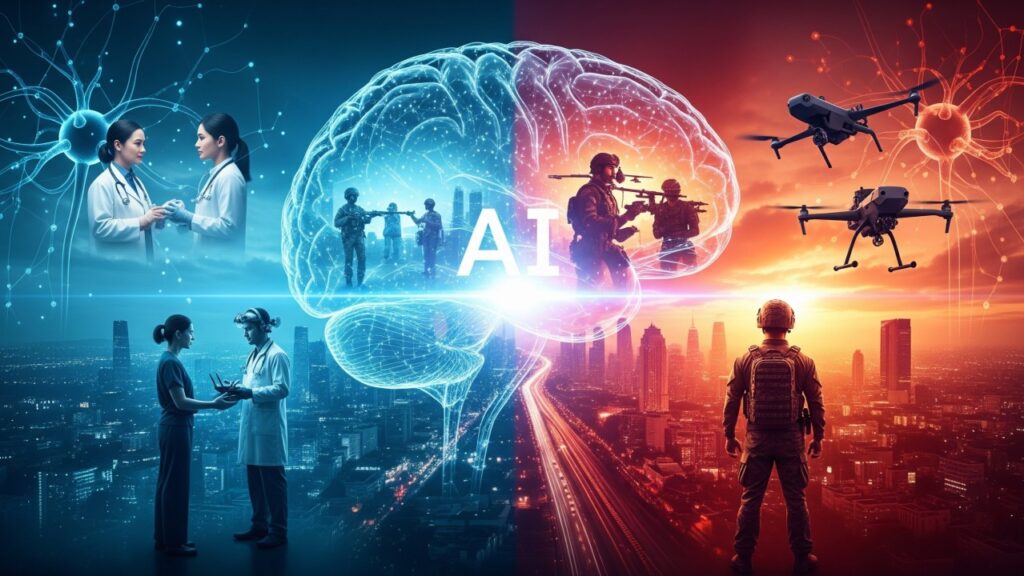
The Benefits: How AI is Powering Progress
1. A Revolution in Healthcare
The U.S. healthcare system has seen a massive upgrade thanks to AI integration.
- Early Diagnosis: AI algorithms now analyze MRIs and X-rays with higher accuracy than humans, identifying diseases like cancer and Alzheimer’s years before symptoms appear.
- Drug Discovery: Pharmaceutical companies in the US are using AI to develop new life-saving drugs in months rather than decades, significantly lowering research costs.
2. Economic Growth and Efficiency
AI has become a massive engine for the American economy.
- Boost in Productivity: Automation of mundane tasks—like scheduling, data entry, and basic coding—has allowed the American workforce to focus on high-level creative and strategic work.
- The Rise of New Careers: While some roles have changed, the demand for AI Prompt Engineers, Data Ethicists, and Machine Learning Specialists has skyrocketed, offering high-paying opportunities for the next generation.
3. Environmental Impact
The U.S. is leveraging AI to fight climate change. Smart grids powered by AI are optimizing energy distribution across states, reducing carbon footprints and making renewable energy more reliable.
The Drawbacks: The Risks We Face
1. Job Displacement and Economic Inequality
The most pressing concern in 2026 is the shift in the labor market.
- Routine Roles at Risk: Entry-level positions in customer service, administrative support, and even basic legal research are being replaced by AI agents.
- The Skills Gap: There is a growing divide between those who know how to use AI and those who don’t, leading to concerns about increased wealth inequality.
2. The Crisis of Misinformation (Deepfakes)
The rise of hyper-realistic AI-generated images and videos has created a “trust crisis.”
- Political Manipulation: Deepfakes have been used to spread false information during elections, making it difficult for citizens to distinguish between reality and fabrication.
- Security Risks: Cybercriminals are now using AI to craft sophisticated phishing attacks that are nearly impossible to detect.
3. Privacy and Data Ethics
To function effectively, AI requires massive amounts of data. This has sparked intense debates in the U.S. regarding how tech giants (like Google, Meta, and OpenAI) collect and use personal information without explicit consent.
At a Glance: 2026 Key Statistics
| Impact Area | Key Finding |
| Economy | AI contributes approximately 1.2% annual growth to the US GDP. |
| Workforce | Nearly 30% of US tasks are now handled by AI automation. |
| Healthcare | Diagnostic accuracy has improved by nearly 40% in AI-integrated clinics. |
💡 My Personal Take: Why You Shouldn’t Panic
In my opinion, AI is like a power tool. If you don’t know how to use a chainsaw, it’s dangerous. But if you learn how to handle it, you can build a house in half the time.
The biggest mistake people make is thinking they can “wait out” the AI trend. You can’t. But you can adapt. AI probably won’t take your job, but a human who knows how to use AI might.
🛡️ How to “AI-Proof” Your Career
If you want to stay relevant in the 2026 US job market (or anywhere else), here is your game plan:
- Double Down on “Human” Skills: AI is great at logic, but it’s terrible at Empathy, Leadership, and Conflict Resolution. Focus on becoming a better communicator and a better leader. These are things a machine simply cannot replicate.
- Become an “AI Pilot”: Don’t ignore the tools. Whether it’s ChatGPT, Midjourney, or specialized industry software, learn how to use them to do your work faster. Be the person who knows how to direct the AI.
- Stay “Beta”: The world is moving too fast to stop learning. Make it a habit to spend 30 minutes a week checking out a new AI tool or reading a tech update. Being “teachable” is the most valuable skill you can have right now.
Conclusion
In 2026, AI is like a powerful new engine. It can take us to amazing places (better health, easier work), but if we don’t have a steering wheel (good laws and ethics), we might crash.
The goal for the US right now isn’t to stop AI—that’s impossible—it’s to make sure it works for us, not against us.